
- All
- Product Name
- Product Keyword
- Product Model
- Product Summary
- Product Description
- Multi Field Search
Views: 0 Author: Site Editor Publish Time: 2026-06-02 Origin: Site


Mobility should bring freedom, not frustration. Yet many seniors and disabled individuals feel restricted because standard mobility aids prove too bulky for spontaneous travel. Balancing everyday mobility needs against transportation realities poses a major dilemma for buyers. Traditional models demand expensive vehicle modifications like mechanical lifts or ramps. These heavy barriers make folding models the practical solution for active users wanting to regain their independence.
This guide helps you transition from merely browsing to confidently evaluating your best options. We provide a clear framework for selecting a device based on your physical capabilities, primary travel modes, and available budget. You will discover how to avoid common purchasing mistakes, such as severely underestimating the actual lifting weight. By the end of this article, you will know exactly which features matter most for your personal comfort and daily convenience.
Weight vs. Stability: Ultra-lightweight models prioritize portability but may sacrifice outdoor stability and battery range.
Folding Mechanism: The choice between an auto folding mobility scooter and a manual folder depends entirely on the user's hand dexterity and lifting capacity.
Travel Compliance: Not all lithium-ion batteries are FAA-approved for commercial flights; verifying Watt-Hour (Wh) limits is non-negotiable for frequent travelers.
Material Matters: Advancements like the carbon fiber electric scooter frame drastically reduce lifting weight but come at a premium price point.
Traditional motorized chairs often limit your spontaneity. If you want to visit a local park or run a quick errand, dragging out heavy equipment feels exhausting. A portable electric scooter eliminates this transportation barrier completely. You can fold it to fit inside a standard car trunk. You can roll it directly into narrow cruise ship cabins. You can even gate-check it at major airports just like a baby stroller.
This transition also promotes vital caregiver independence. Family members frequently suffer back strain from constantly lifting heavy medical equipment. Folding models eliminate the need for cumbersome lifting hoists. They also remove the need to purchase expensive wheelchair-accessible vehicles. Caregivers simply fold the device, place it in the cargo area, and drive away.
However, we must align these devices to their correct use cases. They excel in specific environments but struggle in others.
Perfect Environments: Indoor shopping malls, grocery stores, paved walking paths, airports, and cruise ships.
Unsuitable Environments: Off-road trails, steep inclines, thick grass, gravel driveways, and all-weather exposure.
Best Practice: Always evaluate your primary travel routes before purchasing. If you spend 80% of your time indoors or on paved surfaces, a compact folding model serves you perfectly.
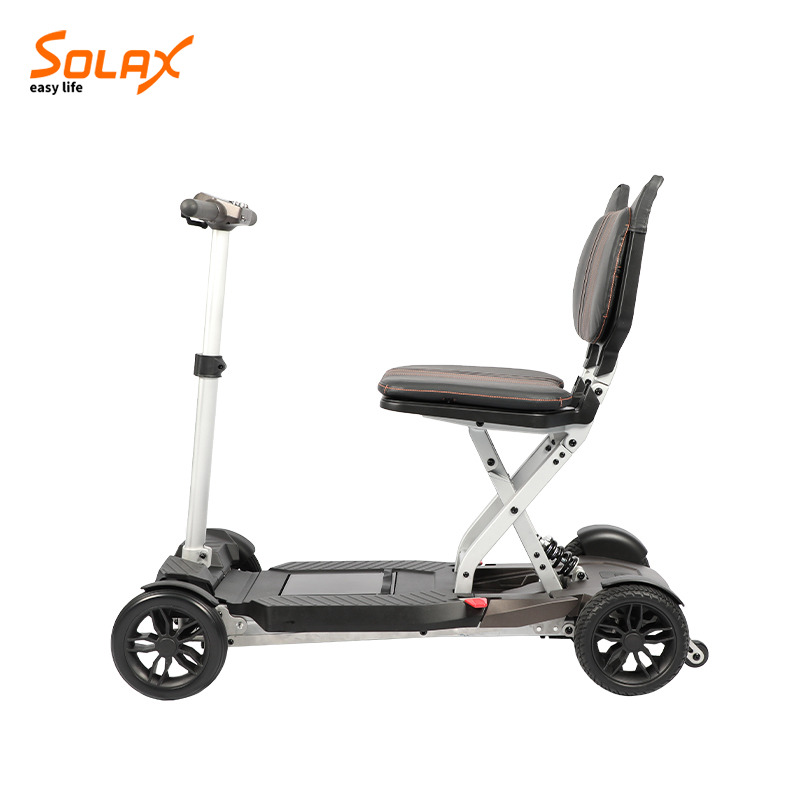
Selecting the right folding mechanism determines how easily you can use the device daily. Your choice heavily depends on hand strength, balance, and independence goals.
Manual designs require you to release a lever or pull a pin to collapse the frame. You must physically guide the device into its folded position.
Pros: They feature fewer electronic components. This means fewer things can break over time. They generally weigh less overall and cost less upfront.
Cons: The process requires bending over. You need moderate hand strength to manipulate levers.
Best For: Users who travel alongside a capable caregiver. They also suit individuals retaining enough dexterity and balance to safely operate hinges.
These sophisticated devices collapse or expand electronically. You typically press a button on a remote control or the dashboard.
Pros: The entire process takes just seconds. An auto folding mobility scooter maximizes independence for users experiencing severe mobility restrictions.
Cons: They weigh marginally more due to the internal folding motor. If the main battery dies, engaging the manual override can feel cumbersome.
Best For: Solo travelers. They are highly recommended for individuals facing severe arthritis or strict lifting restrictions.
Feature | Manual Folding | Auto Folding |
|---|---|---|
Ease of Use | Requires physical bending and pulling | Push-button remote control operation |
Overall Weight | Typically lighter (no folding motor) | Slightly heavier (internal motor added) |
Maintenance | Low (purely mechanical hinges) | Moderate (electronics and actuators) |
Price Point | More budget-friendly | Premium pricing |
Marketing brochures often highlight impressive specifications. Yet real-world usability depends on reading between the lines. Let us examine the core criteria you must evaluate.
Buyers frequently confuse total weight and lifting weight. Total weight includes the frame, battery, and seat. A scooter might weigh 55 pounds fully assembled. However, you rarely lift it fully assembled. Removing the battery and the seat might reduce the actual lifting weight to just 40 pounds. Always check the weight of the heaviest individual piece before buying.
Aircraft-grade aluminum remains the industry standard. It provides excellent durability and reasonable weight. Recently, manufacturers introduced advanced materials. A carbon fiber electric scooter offers a superior strength-to-weight ratio. Carbon fiber frames drastically cut the physical strain of loading the device into a vehicle. Paying the premium price yields an excellent return on investment if you travel frequently.
You must balance maneuverability against weight capacity. A narrow wheelbase navigates tight corners effortlessly. However, folding models typically cap their maximum weight capacity between 250 and 300 pounds.
Pay close attention to seat dimensions. Compact models often feature narrower seats. They also lack the deep, plush suspension found on heavy-duty outdoor models. Measure your current comfortable chair and compare those numbers to the scooter specifications.
Battery chemistry defines your travel range and device longevity. Sealed Lead Acid (SLA) batteries cost less but weigh significantly more. Lithium-ion batteries dominate the premium market because they remain lightweight and hold charges longer.
Manufacturers typically advertise maximum ranges under perfect conditions. In reality, expect a real-world range of 8 to 13 miles. Variables like rider weight, inclines, and frequent stops will deplete the battery faster.
Traveling requires meticulous planning. Navigating airports and cruise terminals demands strict adherence to regulatory standards.
Flying requires absolute compliance. You can fly easily if you prepare correctly. You must use an approved lightweight mobility scooter designed for air travel.
Lithium-ion batteries must generally measure under 300 Watt-Hours (Wh). Alternatively, airlines permit two spare batteries under 160Wh each.
You must remove the battery before the device enters the cargo hold. You must carry the battery safely into the aircraft cabin.
Always tape over the battery terminals to prevent accidental short circuits during transit.
Cruise ships present unique spatial challenges. You will navigate narrow passenger hallways and tight elevator banks. Standard cabin doorways usually require a clearance width of 24 inches or less. Measure the widest point of your mobility aid before booking your cabin. If it exceeds 24 inches, you must request a designated accessible cabin.
Gate checking protects your independence until the moment you board. You ride the device directly down the jet bridge. Baggage handlers then store it underneath the plane.
Common Mistakes to Avoid: Never leave loose accessories attached. Remove baskets, cup holders, and custom cushions. Photograph your device thoroughly at the gate. These photos provide essential evidence if baggage handlers damage the frame during the flight.
Brochures show smiling people effortlessly tossing mobility aids into car trunks. Real life looks quite different. You need practical strategies to handle daily usage.
A frame may fold compactly, but lifting 40 to 50 pounds of deadweight into an SUV cargo bay remains physically demanding. Bending over a bumper creates significant lower back strain. We suggest leveraging trunk sliding mats. These mats allow you to rest the front wheels on the bumper and slide the unit inward. Alternatively, investigate portable, non-permanent trunk hoists designed for light loads.
Maintain healthy skepticism regarding "all-terrain" claims on micro-wheels. Small, solid tires lack air cushioning. They will quickly transfer heavy vibration to your spine if you ride over cobblestones, cracked sidewalks, or textured pavement. These devices prioritize indoor maneuverability over outdoor shock absorption.
Compact folding hinges endure massive stress over time. Dust, dirt, and pet hair easily accumulate in the joints. You must perform regular maintenance. Wipe down the hinges monthly. Additionally, automated models require occasional remote-control synchronization. Keep your manual handy to reset the pairing if the remote temporarily loses connection.
You now understand the core criteria and implementation realities. It is time to finalize your selection systematically.
Identify Maximum Lifting Capacity: Test how much weight you can safely lift waist-high. If your limit sits under 35 pounds, prioritize a carbon fiber model or a unit that completely disassembles rather than just folds.
Identify Primary Use: Determine where you will spend the most time. If you mostly plan for flights and cruises, prioritize strict FAA compliance and narrow wheelbases.
Identify Dexterity Level: Assess your hand strength. If bending or pulling levers causes joint pain, default immediately to an automated mechanism.
Delineate clearly which features justify an upcharge. Lithium-ion batteries remain absolutely worth the extra cost due to their lifespan and lightweight nature. Carbon frames justify their price if you lack upper body strength. Ergonomic delta tillers benefit anyone experiencing hand fatigue.
Conversely, you can often skip expensive factory-branded cup holders or proprietary travel bags. Aftermarket accessories usually provide similar utility for much less money. Focus your budget entirely on the frame, battery, and folding mechanism of your chosen folding mobility scooter.
The best folding mobility aid is never simply the one claiming the highest top speed. The optimal choice aligns strictly with your physical limitations and your primary travel environment. By prioritizing lifting weight over total weight, you protect your back and your caregivers. By selecting the correct folding mechanism, you guarantee daily independence.
Here are your immediate next steps:
Grab a measuring tape and record the exact dimensions of your vehicle's cargo space.
Contact your preferred airline and verify their specific medical device policies regarding battery wattage.
Measure your favorite chair at home to ensure the scooter's seat width matches your comfort needs.
Taking these final steps ensures your purchase brings you true freedom and seamless travel for years to come.
A: Medicare typically only covers mobility devices deemed medically necessary for in-home use. Since travel and folding models are specifically designed for outdoor lifestyles and easy transport, Medicare rarely provides coverage for them. You will usually need to purchase these devices out-of-pocket.
A: Yes, you can fly with them if you follow regulations. The lithium-ion battery must be FAA-compliant, which generally means it remains under 300Wh. You must remove the battery from the frame at the gate and carry it into the passenger cabin.
A: Carbon fiber models currently lead the market in lightweight design. By utilizing advanced aerospace materials, these frames often weigh between 30 to 40 pounds once you remove the battery. They offer the best solution for individuals with strict lifting limitations.
A: Mechanical actuators are generally very reliable. However, the automated process relies entirely on battery power. The most common "breakdown" issue occurs when users let the battery die completely, which halts the electronic folding process. Keeping the battery charged prevents most operational issues.


