
- All
- Product Name
- Product Keyword
- Product Model
- Product Summary
- Product Description
- Multi Field Search
Views: 0 Author: Site Editor Publish Time: 2026-06-03 Origin: Site


For frequent travelers and individuals facing mobility barriers, heavy and rigid scooters often create an unintended dependence on caregivers. They heavily limit independent travel and spontaneous outings. Moving bulky equipment is a grueling task you likely want to avoid on a daily basis. The transition to a premium lightweight mobility scooter built on a carbon fiber chassis effectively solves this primary pain point. It eliminates the struggle of lifting heavy frames without sacrificing structural integrity or rider weight capacity.
This guide provides a clear, evidence-based evaluation framework for assessing modern carbon fiber mobility solutions. You will learn how to separate clever marketing claims from daily functional realities. We will deeply explore material benefits, examine specific portability features, navigate complex airline compliance regulations, and outline actual performance limitations. Ultimately, you will gain the knowledge needed to make a confident, informed decision for your personal mobility needs.
Material Efficiency: Carbon fiber frames reduce overall weight by up to 40% compared to traditional aluminum, allowing baseline weights as low as 30–35 lbs.
Portability Mechanics: Top-tier models transition seamlessly from a ridable vehicle to a compact, suitcase-style towable unit in seconds.
Compliance Realities: "Airline approved" claims require strict verification of battery watt-hours (Wh); high-capacity dual batteries often fail TSA/FAA requirements.
Use-Case Boundaries: These scooters excel in tight indoor spaces and paved surfaces but are not engineered for rugged outdoor off-roading.
The mobility industry previously relied heavily on aluminum alloys to balance durability and weight. However, recent manufacturing advancements introduced carbon fiber as a superior alternative. This material fundamentally changes how you interact with personal transit devices.
Carbon fiber relies on woven carbon atoms suspended in a rigid resin matrix. This specific construction yields incredibly high tensile strength. Manufacturers use 100% carbon fiber to produce frames weighing under 40 pounds before battery installation. Despite this ultra-lightweight profile, these frames safely support rider weights up to 330 pounds. This creates an unparalleled weight-to-capacity ratio. You no longer have to choose between a sturdy ride and a manageable lifting weight.
Durability remains a critical concern for any daily-use vehicle. A well-engineered carbon fiber electric scooter boasts exceptional fatigue resistance. Unlike aluminum, which can develop micro-cracks along welded joints over time, carbon fiber distributes stress evenly across its woven structure. Furthermore, carbon fiber offers natural shock-absorbing properties. It dampens subtle vibrations from paved sidewalks or tiled floors, providing a noticeably smoother ride than rigid metal alloy counterparts.
Material Metric | Traditional Aluminum | Premium Carbon Fiber |
|---|---|---|
Average Frame Weight | 55 - 75 lbs | 30 - 40 lbs |
Tensile Strength | Moderate (Prone to bending) | Extremely High (Resists deformation) |
Vibration Dampening | Low (Transmits bumps to rider) | High (Naturally absorbs micro-shocks) |
Fatigue Resistance | Weld points degrade over time | Seamless structure resists daily wear |
Marketing materials often highlight total assembled weight. However, this number rarely reflects your daily reality. You must evaluate a scooter by looking at its heaviest individual component when disassembled or folded. This single metric dictates the true physical lifting requirement. For example, if a scooter weighs 45 pounds total but its heaviest foldable frame piece weighs 35 pounds, you only ever lift 35 pounds. Prioritizing the heaviest piece metric ensures you buy a device you can actually lift into a vehicle trunk independently.
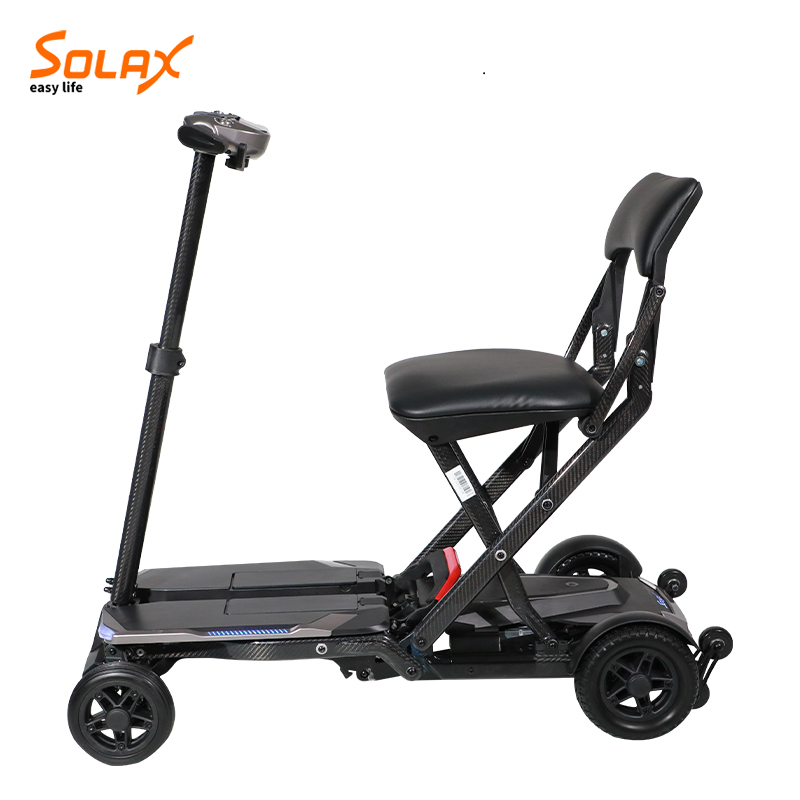
Portability extends far beyond mere weight. A scooter must collapse efficiently and maneuver easily when not in use. Functional design separates adequately portable devices from truly exceptional travel companions.
Designers generally offer two distinct folding paths. Manual quick-fold designs rely on strategic hinges and mechanical latches. Conversely, an auto folding mobility scooter utilizes an internal motor and a remote control to collapse the frame automatically. While auto-folding mechanisms provide hands-free convenience, they introduce extra weight and potential electronic failure points. Manual folding systems are notably lighter. They rely on simple, reliable physics rather than vulnerable wiring.
A typical manual quick-fold process involves three simple steps:
Release the primary locking latch located near the floorboard.
Fold the seat and tiller downward until they meet the chassis.
Engage the secondary lock to secure the unit in its compact state.
Lifting should always be a last resort. Top-tier designs allow the folded unit to rest on its own wheels. You can extend a handle and tow the collapsed scooter exactly like a piece of rolling luggage. This operational advantage drastically reduces physical strain. You can smoothly roll the device through hotel lobbies, airport terminals, or long driveways without carrying a single pound.
Compact dimensions matter immensely for modern travel. A fully collapsed carbon fiber unit fits securely into tight spaces. You can slide it into standard sedan car trunks alongside luggage. It easily clears the narrow doorways of cruise ship cabins. At home, you can tuck it away in standard apartment closets. By minimizing the storage footprint, these devices respect your living space and simplify complex travel logistics.
Consumers often form unrealistic expectations regarding where travel scooters can operate. Understanding structural boundaries prevents frustrating breakdowns and ensures safe daily operation.
Engineers design these devices specifically for urban and indoor environments. They perform flawlessly on ADA-compliant ramps, which feature a manageable 1:12 slope ratio. You will experience smooth handling on indoor tile, hardwood floors, and well-maintained paved sidewalks. Furthermore, their compact width effortlessly navigates standard 30-inch interior door frames without scraping the sides.
Navigating narrow hallways and cramped elevators requires a highly responsive steering system. A tight turning radius proves essential for daily independence. Top models boast a sub-30-inch turning radius. This allows you to pivot smoothly in confined spaces without resorting to exhausting, multi-point turns. High maneuverability directly translates to a stress-free indoor driving experience.
We must explicitly state the operational limits of a lightweight portable electric scooter. These units generally feature a low ground clearance of 1.5 to 2 inches and rely on solid, puncture-proof tires. Consequently, they are entirely unfit for loose gravel, thick grass, mud, or extreme off-road trails. Attempting to cross rough terrain will rattle the frame, damage the underside components, and likely leave you stranded.
Ideal Environments: Shopping malls, cruise ships, paved paths, airports, museums.
Environments to Avoid: Cobblestone streets, sandy beaches, thick lawns, unpaved nature trails.
Safety systems require automatic engagement. Premium models utilize intelligent electromagnetic or regenerative braking systems. When you release the throttle joystick, the brakes engage instantly and automatically. This system prevents the scooter from rolling backward on inclines. It offers absolute peace of mind, knowing the device will halt itself immediately without requiring you to squeeze a manual brake lever.
Air travel presents the ultimate test for mobility equipment. Regulatory misunderstandings frequently cause stressful delays at airport security checkpoints.
Many brands splash the phrase "Airline Approved" across their marketing materials. However, this approval depends entirely on the lithium-ion battery's specific capacity. The Federal Aviation Administration (FAA) and the Transportation Security Administration (TSA) do not approve brands; they regulate watt-hours (Wh). A scooter is only compliant if its power source falls within strict federal limits.
Travel-friendly batteries must meet specific thresholds. For medical devices, aviation authorities typically mandate a maximum of 300 Wh for a single battery, or two spare batteries not exceeding 160 Wh each. High-capacity dual batteries designed for extended range often fail these requirements. Additionally, you must completely remove the lithium-ion battery prior to gate checking the scooter frame. You carry the battery with you inside the passenger cabin to prevent thermal runaway risks in the cargo hold.
Preparation accelerates the security process. We highly recommend carrying a physical copy of the manufacturer’s battery specification sheet. If your device qualifies as an FDA Class II medical device, bring that documentation as well. Presenting official paperwork immediately answers TSA questions, verifies the watt-hour rating, and expedites your clearance through the security line.
Choosing the correct model requires matching specific hardware features to your personal physical requirements. Do not base your decision solely on aesthetic appeal.
Standard frames often cramp taller individuals. Assess models offering significant adjustability. Look for a folding mobility scooter featuring a telescoping handle that adjusts to your arm length. Some premium models feature an extended chassis base, providing an extra 9 inches of legroom. This accommodation prevents knee strain for taller users without compromising the vehicle's center of gravity or lateral stability.
Daily use introduces dirt, spills, and general wear. You need a design that facilitates quick cleaning. Look for practical engineering choices, such as easily removable seatbacks and base cushions. Detachable components allow you to wipe down the carbon fiber frame thoroughly. They also let you replace worn upholstery without sending the entire unit to a service center.
Modern features add genuine value to the user experience. Evaluate add-ons based on their practical utility. We have organized a simple evaluation chart to help you assess these technologies.
Technology Feature | Practical Daily Value |
|---|---|
NFC Intelligent Ignition | Acts as a robust anti-theft system. Unlocks via key fob or smartphone, preventing unauthorized use in public spaces. |
Color LED Display | Provides highly visible battery monitoring in direct sunlight, reducing range anxiety. |
Accessible USB Charging Ports | Allows you to charge your smartphone directly from the scooter's battery during long travel days. |
Off-Board Charging Cable | Lets you leave the heavy frame in the trunk while bringing only the lightweight battery indoors to charge. |
A premium carbon fiber lightweight mobility scooter represents a profound investment in your independent mobility. It removes the physical barriers of heavy lifting and complex transportation. However, this investment only yields returns if your daily routes align with the vehicle's structural constraints and terrain limitations. Respecting the device's boundaries ensures years of reliable service.
As you move forward, take immediate, actionable steps. Measure your primary vehicle's exact trunk dimensions and compare them against the scooter's folded specifications. Verify the exact battery watt-hours against the published policies of your preferred commercial airline. Finally, if possible, visit a local showroom to physically test the lifting weight yourself. These practical steps guarantee you select a device that perfectly supports your lifestyle.
A: Yes, provided the lithium-ion battery complies with FAA/TSA watt-hour limits (usually under 300 Wh). The battery must be removed and carried in the passenger cabin, while the carbon fiber frame is gate-checked just before you board the aircraft.
A: Auto-folding models use an internal motor and remote to collapse the frame, adding convenience but also extra weight and potential points of mechanical failure. Manual quick-fold models are typically lighter and rely on simple mechanical latch releases.
A: Common troubleshooting involves checking the freewheel or drive lever. If the scooter is set to "Neutral" (manual push mode) rather than "Drive," built-in safety mechanisms will purposefully prevent the motor and ignition from engaging.
A: It is highly discouraged. With low ground clearance (typically 1.5 to 2 inches) and smaller solid tires, lightweight travel models are engineered primarily for flat, paved surfaces and indoor use. They will struggle or get stuck on rough terrain.


