
- All
- Product Name
- Product Keyword
- Product Model
- Product Summary
- Product Description
- Multi Field Search
Views: 0 Author: Site Editor Publish Time: 2026-05-01 Origin: Site


Two mobility scooters can look similar in a product photo, but the real difference appears when someone has to lift, fold, store, or travel with the device. Frame material, folded size, battery layout, and seating comfort all affect daily use. That is why a Carbon Fiber Mobility Scooter should be reviewed through real handling scenarios, not only through appearance.
This guide explains who benefits from a Carbon Fiber Mobility Scooter and how products such as carbon fiber mobility scooter support portable mobility planning. It is designed for distributors, retailers, mobility equipment buyers, and care providers who need a clear product evaluation method.
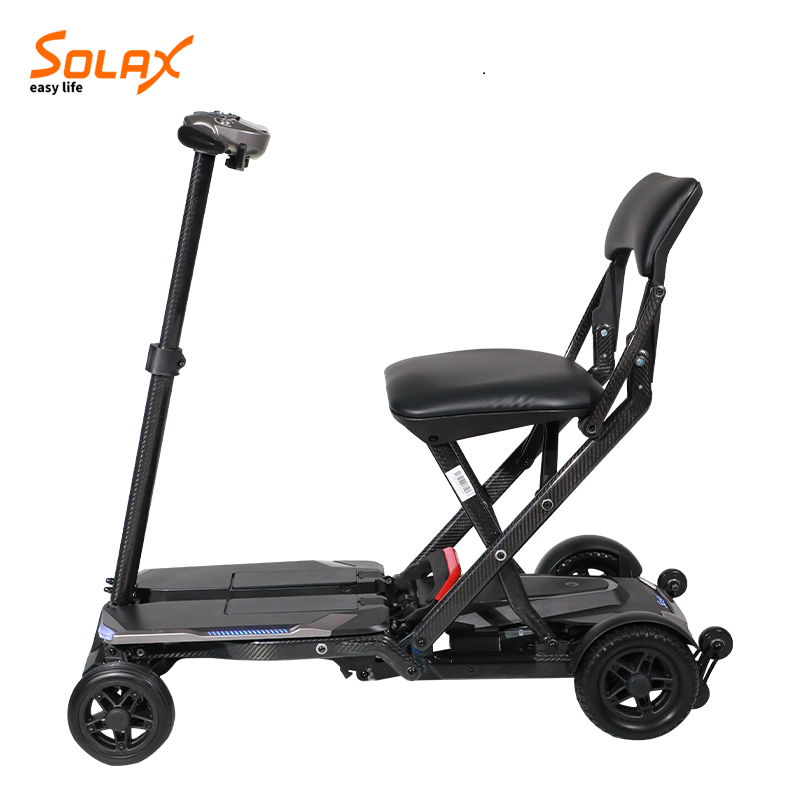
A Carbon Fiber Mobility Scooter is a mobility equipment built around carbon fiber frame construction combined with compact folding and electric mobility functions. It is designed to help adults manage routine movement with more confidence, especially when walking longer distances or handling repeated transitions becomes difficult. The product should not be evaluated as a simple vehicle. It should be reviewed as a daily support tool that affects storage, transport, comfort, and user independence.
For buyers, the main question is how well the device fits the intended user. Some users need a product that folds easily. Others need better seat support, compact turning, or a device that can move between home, car, and public spaces. The right selection depends on real use patterns.
Solax offers products such as carbon fiber mobility scooter, and buyers may compare related options like portable electric scooter or the broader folding scooters category when building a product lineup. These internal product links help readers understand how one mobility option relates to another.
A strong review of a Carbon Fiber Mobility Scooter should include user profile, travel plan, storage space, caregiver involvement, technical specification, and service support. When these elements are considered together, the product choice becomes much more practical.
Daily mobility is not only about distance. It is about access, timing, confidence, and routine. A person may need help moving through a hallway, reaching a vehicle, shopping with family, or staying active in a community setting. A Carbon Fiber Mobility Scooter can support those goals when its design matches the user’s environment.
Portability is especially important. A device that cannot be folded, stored, charged, or transported conveniently may remain unused even if its core function is acceptable. Buyers should therefore evaluate the complete user journey. That includes taking the device out, setting it up, using it, storing it, and preparing it for the next trip.
Distributors and retailers should also think about explanation. Mobility products require clear communication because users and caregivers often have practical concerns. They want to understand handling, comfort, battery care, and service support. A supplier that provides clear product information can make the sales and support process smoother.
A well selected Carbon Fiber Mobility Scooter can improve convenience, reduce caregiver strain, and make routine outings easier to plan. That value comes from matching features to real life rather than choosing only by appearance.
Lightweight Frame is a practical feature that affects how the user experiences Carbon Fiber Mobility Scooter. In mobility equipment, a feature is only valuable when it makes daily movement easier, safer to manage, or more comfortable. A buyer should therefore connect each feature to a specific user scenario.
For example, a lightweight structure may help caregivers move the device, while a folding frame may help with apartment storage or vehicle loading. A control layout may look simple, but it must also be reachable and understandable for the user. These details should be tested in real conditions whenever possible.
When evaluating lightweight frame, buyers should ask for product specifications, usage guidance, and realistic handling information. A clear supplier response helps distributors explain the product accurately and helps users set proper expectations.### Folding Structure in Carbon Fiber Mobility Scooter
Folding Structure is a practical feature that affects how the user experiences Carbon Fiber Mobility Scooter. In mobility equipment, a feature is only valuable when it makes daily movement easier, safer to manage, or more comfortable. A buyer should therefore connect each feature to a specific user scenario.
For example, a lightweight structure may help caregivers move the device, while a folding frame may help with apartment storage or vehicle loading. A control layout may look simple, but it must also be reachable and understandable for the user. These details should be tested in real conditions whenever possible.
When evaluating folding structure, buyers should ask for product specifications, usage guidance, and realistic handling information. A clear supplier response helps distributors explain the product accurately and helps users set proper expectations.### Battery Powered Drive in Carbon Fiber Mobility Scooter
Battery Powered Drive is a practical feature that affects how the user experiences Carbon Fiber Mobility Scooter. In mobility equipment, a feature is only valuable when it makes daily movement easier, safer to manage, or more comfortable. A buyer should therefore connect each feature to a specific user scenario.
For example, a lightweight structure may help caregivers move the device, while a folding frame may help with apartment storage or vehicle loading. A control layout may look simple, but it must also be reachable and understandable for the user. These details should be tested in real conditions whenever possible.
When evaluating battery powered drive, buyers should ask for product specifications, usage guidance, and realistic handling information. A clear supplier response helps distributors explain the product accurately and helps users set proper expectations.### Compact Storage Footprint in Carbon Fiber Mobility Scooter
Compact Storage Footprint is a practical feature that affects how the user experiences Carbon Fiber Mobility Scooter. In mobility equipment, a feature is only valuable when it makes daily movement easier, safer to manage, or more comfortable. A buyer should therefore connect each feature to a specific user scenario.
For example, a lightweight structure may help caregivers move the device, while a folding frame may help with apartment storage or vehicle loading. A control layout may look simple, but it must also be reachable and understandable for the user. These details should be tested in real conditions whenever possible.
When evaluating compact storage footprint, buyers should ask for product specifications, usage guidance, and realistic handling information. A clear supplier response helps distributors explain the product accurately and helps users set proper expectations.
In home to vehicle transfers, Carbon Fiber Mobility Scooter should be judged by how well it solves real movement challenges. A device may look attractive in a product image, but daily value depends on how it turns, folds, stores, and feels after repeated use. Buyers should review the device from the user’s position rather than from the showroom floor only.
Caregivers and retailers also need practical details. They may ask how the device is lifted, whether it fits into common storage spaces, how battery charging is managed, and how the user enters or exits the seat. These questions are not minor details. They decide whether the product becomes part of a daily routine.
For this application, selection should include product specification review, user comfort checks, demonstration planning, and after sales support evaluation. When these points are handled early, Carbon Fiber Mobility Scooter becomes easier to recommend and easier to support.
In travel and hotel movement, Carbon Fiber Mobility Scooter should be judged by how well it solves real movement challenges. A device may look attractive in a product image, but daily value depends on how it turns, folds, stores, and feels after repeated use. Buyers should review the device from the user’s position rather than from the showroom floor only.
Caregivers and retailers also need practical details. They may ask how the device is lifted, whether it fits into common storage spaces, how battery charging is managed, and how the user enters or exits the seat. These questions are not minor details. They decide whether the product becomes part of a daily routine.
For this application, selection should include product specification review, user comfort checks, demonstration planning, and after sales support evaluation. When these points are handled early, Carbon Fiber Mobility Scooter becomes easier to recommend and easier to support.
In shopping centers and public spaces, Carbon Fiber Mobility Scooter should be judged by how well it solves real movement challenges. A device may look attractive in a product image, but daily value depends on how it turns, folds, stores, and feels after repeated use. Buyers should review the device from the user’s position rather than from the showroom floor only.
Caregivers and retailers also need practical details. They may ask how the device is lifted, whether it fits into common storage spaces, how battery charging is managed, and how the user enters or exits the seat. These questions are not minor details. They decide whether the product becomes part of a daily routine.
For this application, selection should include product specification review, user comfort checks, demonstration planning, and after sales support evaluation. When these points are handled early, Carbon Fiber Mobility Scooter becomes easier to recommend and easier to support.
A Carbon Fiber Mobility Scooter works by combining a frame, motor, battery system, control interface, wheels, braking system, and seating or support structure. Each part has a role, but the user experiences the product as one complete device. Smooth performance depends on how well those parts work together.
The frame affects handling and storage. The motor and battery affect movement planning. The control system affects user confidence. The braking system affects stopping behavior. Seating affects comfort during repeated use. Wheels and turning radius affect indoor and outdoor movement. If one area is weak, the entire user experience can suffer.
Buyers should test the product through realistic scenarios. Can the user turn in a narrow area? Can the caregiver fold the device without confusion? Can the battery be charged conveniently? Can the product be moved into a vehicle or stored in a small space? These questions reveal more than a specification sheet alone.
Product evaluation should also include instruction clarity. A mobility device may be technically well designed, but if users do not understand setup, charging, folding, or routine care, satisfaction can drop. Clear manuals, support videos, and distributor training help turn product features into real value.
A careful comparison should focus on practical factors rather than brand names. Buyers need to know whether the device is suitable, supportable, and consistent across orders. The following table uses anonymous competitors to keep the review focused on function and sourcing quality.
Evaluation Area | Solax | Competitor A | Competitor B | Industry Average |
|---|---|---|---|---|
Main product focus | Carbon Fiber Mobility Scooter | Similar mobility device | General transport model | Application dependent |
Portability review | Lightweight frame | Standard folding claim | Limited handling detail | Varies by model |
User comfort | Seat, control reach, and routine movement review | Basic comfort notes | Sparse information | Mixed practice |
Documentation | Product page, specifications, and service discussion | Basic product sheet | Limited notes | Varies by supplier |
Buyer fit | Distributors, retailers, care providers, and adult users | Occasional users | Trial projects | Depends on use case |
This comparison format helps purchasing teams avoid decisions based on a single feature. A mobility product must work as a complete system. Weight, comfort, folding method, battery care, service support, and documentation all matter. The best option is the one that fits the target user and can be supported over time.
Technical specifications should be reviewed in plain language. Numbers are useful, but they must connect to daily user needs. A compact folded size matters because it affects storage. Battery range matters because it affects travel planning. Turning radius matters because it affects indoor movement. Seat comfort matters because it affects user acceptance.
Technical Point | What Buyers Should Review | Why It Matters |
|---|---|---|
Lightweight Frame | Confirm how lightweight frame affects daily handling and transport | Helps match Carbon Fiber Mobility Scooter to real user needs |
Folding Structure | Review folding points, locking structure, and storage size | Supports home and vehicle planning |
Battery Powered Drive | Check battery handling, charging workflow, and expected range | Improves routine use planning |
Braking System | Confirm braking system under practical turning conditions | Supports safer movement in tight spaces |
Turning Radius | Evaluate comfort during repeated use | Improves user acceptance |
Seat Comfort | Review accessory fit and service support | Helps distributors support customers after delivery |
A specification review should also consider the buyer’s channel. A retailer may need clear comparison notes for customers. A distributor may need stable supply and service parts. A care provider may need training and product documentation. These needs should be discussed before the product is added to a lineup.
Choosing the right Carbon Fiber Mobility Scooter begins with the user profile. Buyers should consider height, weight, balance, control ability, daily travel distance, storage space, and caregiver support. A product that fits one user may not fit another, even if the product category is the same.
The next step is environment review. Will the device be used mainly indoors, outdoors, in shopping areas, in apartments, or during travel? Tight spaces require turning control. Outdoor use may require stronger tires and stable braking. Travel use may require folding, lifting, and battery handling review.
Buyers should also compare support needs. A distributor must know whether spare parts, user manuals, and service guidance are available. Mobility equipment is not a disposable purchase. Long term support affects customer satisfaction and brand trust.
Finally, the product should be tested. Demonstration use can reveal whether the scooter or wheelchair feels stable, folds smoothly, and is easy to control. A written specification is important, but user confidence often comes from direct handling.
Safety in mobility equipment is not only about one component. It is a combination of stable structure, responsive control, reliable braking, suitable speed, clear instructions, and proper user matching. Buyers should avoid assuming that one feature proves overall suitability.
Comfort is equally important. A user may reject a device if the seat is uncomfortable, the controls feel awkward, or the device is difficult to enter and exit. Comfort should be reviewed during realistic use, not just by reading seat dimensions.
User confidence develops when the product behaves predictably. Smooth starting, controlled turning, stable stopping, and clear charging routines all matter. If the user feels uncertain, the device may not be used regularly.
Distributors can improve user confidence by providing clear product explanations, demonstration support, and simple care instructions. These services are part of the product experience even though they are not physical components.
Packaging matters because mobility equipment must arrive protected and ready for setup. Buyers should review carton strength, internal protection, labeling, accessory organization, and assembly instructions. Poor packaging can create avoidable service issues.
Delivery planning should consider product size and handling. A folding product may be compact after setup, but shipping configuration still matters. Buyers should confirm how the device is packed, what accessories are included, and how users will receive instructions.
Service planning is a major part of mobility equipment sourcing. Batteries, chargers, controllers, wheels, and other components may require support over time. Distributors should ask how service parts are organized and how technical questions are handled.
A strong supplier relationship can reduce service stress. When product information is organized and support is responsive, distributors can help customers more effectively.
Mobility equipment buyers are increasingly focused on portability, compact living, travel convenience, and user friendly design. Many customers want a device that fits a real lifestyle rather than a product that only works in ideal conditions. This trend supports demand for folding scooters, compact power chairs, and lightweight mobility solutions.
Another trend is caregiver friendly design. Families and care providers often help users handle devices, so folding method, lifting weight, and charging routines all matter. A product that reduces caregiver effort can be more attractive in practical purchasing decisions.
Retailers also need clearer product education. Customers ask detailed questions about battery handling, transport, turning, comfort, and service. Product pages and sales materials must answer these questions in a simple and accurate way.
The market is moving toward complete solutions rather than isolated devices. Buyers want mobility products, accessories, service support, and documentation that work together. Suppliers that understand this broader need are easier for distributors to build around.
Before selecting a Carbon Fiber Mobility Scooter, buyers should create a checklist based on user needs and channel requirements. The checklist should include user profile, intended environment, storage space, transport method, control ability, battery routine, and caregiver involvement.
Product testing should include folding, unfolding, turning, stopping, charging, and seating comfort. If possible, different users should try the product because mobility needs vary. One person may value light handling, while another may value seat stability or turning control.
Documentation should be reviewed before commitment. Buyers should ask for product specifications, user manuals, accessory details, service support information, and packaging details. Clear documentation helps prevent confusion after products are introduced into the market.
The final decision should balance product function with support capability. A device that looks impressive but is difficult to service may create long term problems. A product that is clear, manageable, and supportable is often the stronger choice for distributors and end users.
A: A Carbon Fiber Mobility Scooter is used to support adults who need help with daily movement, compact travel, storage planning, or caregiver assisted mobility.
A: Buyers should review user needs, folded size, battery system, braking behavior, turning control, comfort, documentation, and service support.
A: A Carbon Fiber Mobility Scooter may support travel when the folded size, battery handling, and transport method match the user’s plan.
A: Important features include stable control, reliable braking, comfortable seating, manageable folding, battery performance, and clear instructions.
A: A Carbon Fiber Mobility Scooter should be compared by portability, comfort, turning space, storage needs, service support, and the user’s daily environment.
A: Supplier support matters because mobility equipment may require documentation, accessory guidance, service parts, and clear answers for distributors and users.
A Carbon Fiber Mobility Scooter should be selected through real user scenarios, not only through product images or broad claims. Buyers should review portability, comfort, control, safety related details, service support, and documentation before adding the product to a mobility lineup. Solax provides related mobility products that help distributors and users compare compact options with clearer context and more practical confidence.


